


Introduction
Agriculture is undergoing a major technological transformation, driven by advanced positioning systems, data analytics, and smart machinery. At the center of this evolution is precision farming gnss and the Rise of Automated Farming, a concept that combines satellite-based navigation with automation to improve efficiency, reduce waste, and increase crop yields. Farmers today are no longer relying solely on manual observation; instead, they are adopting intelligent systems that can map, monitor, and manage fields with remarkable accuracy.
The Role of GNSS in Modern Agriculture
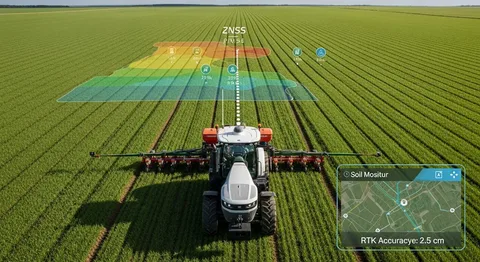
Global Navigation Satellite Systems (GNSS) have become a foundation for precision agriculture. These systems enable farmers to achieve centimeter-level accuracy in field mapping, planting, and harvesting operations. With automation integrated into tractors, drones, and irrigation systems, GNSS allows for highly efficient farming practices that reduce overlap, minimize fuel consumption, and optimize resource use. The growing adoption of Precision Farming GNSS and the Rise of Automated Farming demonstrates how satellite technology is reshaping traditional farming methods into highly efficient, data-driven operations.
Automation and Smart Farming Machinery
Automation is rapidly transforming agricultural workflows. Self-driving tractors, robotic harvesters, and AI-powered monitoring systems are now capable of performing tasks with minimal human intervention. These technologies rely heavily on GNSS data to navigate fields accurately and execute precise actions such as planting seeds in uniform rows or applying fertilizers only where needed. As a result, farms are becoming more productive while reducing labor costs and environmental impact. The integration of Precision Farming GNSS and the Rise of Automated Farming highlights how automation is no longer a future concept but a present-day reality in agriculture.
Benefits of Precision Farming Systems
The combination of GNSS and automation offers multiple benefits for modern farmers. These include improved crop yield, better soil management, reduced input costs, and enhanced sustainability. Real-time data collection also allows farmers to make informed decisions quickly, adapting to weather changes or soil conditions. By leveraging advanced tools, agriculture becomes more predictable and efficient, ensuring food security for a growing global population.
Conclusion
The agricultural sector is entering a new era where technology and farming are deeply interconnected. Precision Farming GNSS and the Rise of Automated Farming represents this shift toward smarter, more efficient agricultural practices. As GNSS technology continues to evolve alongside robotics and artificial intelligence, the future of farming will become even more automated, sustainable, and productive than ever before.
